Introduction
Les Cleveland in his “The Anatomy of Influence” (1972) wrote that “green politics is essentially a reaction to the inability of the ‘old left’ to address the values and aspirations of the young post-materialist minority…the future of green politics is dependent on the way the social democratic party responds to new issues.” This was certainly true for the establishment of Values, but I shall explore the extent to which this is correct for the arrival, and survival, of the Green Party.
The New Zealand Values Party was the world’s first national green party. It contested the 1972 General Election and again in 1975, when it secured just over 5% of the vote, but no seats in parliament due to the first-past-the-post voting system then in place1. The party continued to contest elections but without success until 1989, when, in September of that year, the party’s newsletter Linkletter proposed that the party be wound up. A variety of reasons were given, chief amongst them the perception that the party had failed, that some of the policies had been taken up by other parties, and that they did not have the funds to continue2.

In the 1980s the word green began to be used internationally to encapsulate, in essence, a rejection of materialism and the promotion of environmental protection. In the early 1980s the election of hardline conservative leaders such as Thatcher and Reagan, and rising concern over nuclear power and other threats, gave fresh impetus to the environmental movement and its political expression, including in New Zealand. The Labour party had been elected in July 1984 promising to make New Zealand nuclear-free.
These concerns were to become merged with a desire to transform society to one that is less materialistic, under the umbrella term “green”.
The Formative Years
In June 1988 a “Green Gathering” had been held in Golden Bay, which formed the “Golden Bay Green Coalition”, with Heather Wallace as convenor.3 Other green groups began to form around New Zealand.
Values Party member Bernard Merwood proposed to the remaining 140 voting members of Values in September 1989 that the party continue, and be renamed ‘The Green Party of Aotearoa’.4
The name The Greens had its origins in the German party Die Grṻnen, which met with parliamentary success in the West German elections of 1983 and was a conscious model for those forming the New Zealand Greens in 1989.5
At its Council meeting on 18th November 1989 “Values, the Green Party of Aotearoa” decided to drop the word ‘Values’ and at the same time adopt what was then the international logo for Green politics, a sunflower in a Green circle. The constitution and policies remained unchanged[^7] . The national spokespeople were appointed, Janet McVeagh and Nick Merwood.
The party, under the name of Nick Merwood, issued a press release, which noted that it is “vitally important that those who wish for a Green future are given the chance to vote for it and so are dedicated to providing a full list of candidates [in the election] next year. We invite all those who share the vision of a just and sustainable society to join with us in obtaining it.” (7)
Janet McVeagh was a former Values Party activist from New Plymouth; Nick Merwood, then in his 30s, was from Matakana, north of Auckland. Nick’s father, Bernard, was the party general secretary. Louise Merwood was the party Treasurer and Membership Secretary at this time. (8) Tony Dromgool took on the task of compiling a newsletter to go to 300 selected individuals on the mailing list and to about 40 organisations including news media outlets, libraries and various non-governmental organisations, who were invited to subscribe. The Green Alternative in Wellington, Tasman Greens in Golden Bay, Green Coalition in Russell, Green Lobby in Hamilton, Green Action in New Plymouth and the Mahurangi Greens in Warkworth were the Green groups who were invited to subscribe, and by doing so, to register their interest in joining the new party.

A Green Gathering was called and this was held in Wainuiomata near Wellington in November 1989. This meeting came to a number of conclusions which were carried forward to another gathering in Kaiteriteri, near Motueka, from the 23rd to 25th March, 19906. The agenda for the conference covered such issues as deciding on the right Green structure for New Zealand; developing proposals for that structure; deciding on areas to be covered in Green policy; draft basic policy; and developing specific strategies for the 1990 election.
A Green Charter was decided upon.
Two Green Party of Aotearoa co-convenors were elected, Tony Hartnett and Janet McVeagh.
Chris Thomas of Wellington Green Alternative and spokesperson for The Greens sent a letter out to all Greens on the 1st May 1990 proposing the creation of a single Green Party. [ATL: Green Party correspondence file 2003-176/114]
The Green Council of the Green Party of Aotearoa held a meeting over the weekend of 5th/6th May 1990, at which Chris Thomas’ letter was read aloud. [copy of letter to be loaded]
The Council responded favourably to Chris’ letter, agreeing on the need for political and structural unity within the Green movement. A resolution was passed that it is essential that one Green political party be formed.
It decided to call a follow-up conference to the earlier Kaiteriteri gathering.
A letter came out of this Council meeting which was sent to all green groups around New Zealand under the name of Janet McVeagh. The letter explained that Chris Thomas, had written to The Green Party of Aotearoa proposing a merger of the groups, and a meeting was called for 25th/26th May at the Quaker Settlement in Whanganui to discuss the creation of a single Green Party.
Others who put their names to the green groups letter were Richard Davies, Andy Spence, Leon Roborgh, Nicole Morgan, Wendy Morgan, Tony Dromgool, Fernando Gusingo, Faith Read, Rosemary Shankland and Vic Shankland, Yvonne Amery and Nick Pyle. The letter was sent to the Wellington Green Alternative, Auckland Greens, the Canterbury Greens, the Golden Bay and Tasman Greens, the Green Party of Aotearoa, “and other groups”.7
The topics discussed at Whanganui were:
1. A unification statement
2. What is this group and what is its relationship to other groups?
3. A summary of the Kaiteriteri discussions and reaffirmation of the “Kaiteriteri Green Charter”
4. The name of the party
5. A national structure including common membership, regional structure of 14 regional council areas
6. Process for resignation of officers and election of new office holders for a single party
7. Membership and financial structure
8. Election strategies
9. The selection of candidates for the 1990 election
10. Provision for a policy weekend and a National Conference in August
11. Marketing and publicity
12. Treaty of Waitangi issues
Also up for discussion were the resignation of all existing office holders, the election of office holder
Member Andrew Spence took notes: “Those present…agreed to unify their Green political interests under a single organisation to represent their ideals and policies”. 8 “The Greens” was formed to represent the fifteen regionally autonomous groups which were present at Kaiteriteri under a single organisation, but “…not established as a political party, and many of the groups present did not wish to belong to a political party.” There was resistance to adopting the word “party”; some strongly felt that they did not want the Greens to become a traditional political party. After much discussion it was agreed to become a political party “The Greens: The Green Party of Aotearoa/New Zealand”, the name which remains today, but there was then and remains a sense within The Greens that we are as much a movement, as we are a party, and that this is even more important than being a political party.
During the conference the New Zealand Party, which had been formed in 1984 by Bob Jones in order to defeat the Muldoon government, made an approach to the representatives of the Values Party and the Green Party of Aotearoa to try to persuade them to join a three-party coalition whose aim would be to push for proportional representation. But the Secretary of the new political party The Greens was instructed to write to the groups concerned stating that “they did not wish to be involved with this coalition.”9 The Democrat party did decide to join the coalition, but the New Labour Party and Social Credit joined with the Greens in declining to join. Thus were the seeds sown for a future alliance arrangement.
The Whanganui gathering made three statements of intent:
(1) That they were united as one political Green group
(2) The Greens will consist of autonomous local groups united by a national structure as outlined in the Green Charter and
(3) The Green Charter represents the present state of discussions among the Greens
The proposed structure comprised an elected Council from the 23 regional Green groups, which in turn appointed a governing Executive. Janet McVeagh was appointed as the national contact for candidates. Publicity for the new party was to be the responsibility of Nick Pyle. A publicity working group was established consisting of Allan Hallett, Jenny-Kaye Potaka, Peter Davis, Lee-Ann Brownson, Martin Wallace and Jon Field. Vic and Rosemary Shankland were tasked with obtaining registration for the party with the Electoral Commission.
Three publications were set up: Green Print, Green Link, and Green Web (Green Web was already in existence; it was decided to continue it and to send it to local groups, with Chris Thomas as editor).
The membership system was placed in the hands of local groups. Chas Hamblyn was appointed National Treasurer, Secretary was Stuart Miller, Media Liasion Allan Hallett, Policy Secretaries were Leon Roborgh and Janet MacVeigh, and Tony Hartnett, Jenny-Kaye Potaka, Jon Field, Christine Dann and Yvonne Amery were all appointed Spokespersons. Wendy Morgan and Janine McVeigh were International Liaison representatives.
A policy weekend was planned for 23/24 June in New Plymouth, with Leon Roborgh as the organiser.
An issue of “The Green Web”, dated 30 May 1990, calling itself a “Regional Coordination networking newsletter”, was sent out to all regional groups setting out what had happened at Whanganui. It stated that the event was “an historic ‘tying of the knot’: The Greens and the Green Party of Aotearoa have merged to form a single political organisation….some of those present saw it as the final chapter for The Values Party.” 10
Already, candidates were coming forward for the parliamentary elections later that year.
Stephen Rainbow had been selected for Wellington Central; Gillian Hope for Island Bay; Denis Foot for Miramar; Gary Reese for Ohariu; Kari Haydon for Western Hutt; Leon Roborgh for New Plymouth, and another member standing in Wanganui.
The 1990 Election and the responses of other political parties; the party forms itself
In July 1990 the Green Party reached 8% in the polls; it had qualified for state broadcasting funding during the election campaign in October and scored 6.9% of the votes cast on polling day, 27th October – a remarkable achievement for a party that had only been formed just a few months prior.
The election was followed by a period of self-styled “navel gazing” by party members. A South Island Green Gathering was held at the Old Vicarage in Governor’s Bay near Christchurch on 3rd and 4th November to reflect on what happened and where next, and the Rotorua Greens organised a similar event for the North Island, as a “post-election analysis weekend/experience on the same dates.
From 23rd to 25th November 1990 a further conference was held at Massey University in Palmerston North with 74 delegates and 38 observers. A formal structure was set up and meeting procedures agreed to. The Green Council met on 24th/25th November 1990.
There was a National Conference at Tuakau from 29 March to 1 April 1991. Chris Thomas was appointed General Secretary at that meeting. Teddy Goldsmith from the UK came to speak.
The party elected national officeholders:
Wendy Lynch as female national convenor
Chris Thomas as male national convenor
Christine Dann and Judy Whatley as female speakers
Jon Field and Mike Smith as male speakers
Just prior to this conference Mike Smith has already met with Jim Anderton of the New Labour Party, Matiu Rata of Mana Motuhake and Garry Knapp of Social Credit to talk “of some sort of co-operation to assist the MMP campaign”. 11 This move was not met with approval from all members of The Greens. Smith wrote that “…after many, many, meetings, visits and phonecalls, eight of us – I was joined by Chris Thomas – met in Anderton’s office for the first ‘official’ meeting…we bashed out the basics of an agreement to co-operate on MMP [campaign for electoral reform], with a promise to look at what other areas of policy we had in common, and so the Alliance was conceived”. 12 Smith states that he was the person “most instrumental” in getting the Greens into the Alliance, and this formation of left parties was officially launched on 1st December 1991, but the Green party did not join the Alliance formally until May 1992.
As support for stronger environmental policy gained momentum in New Zealand, the Labour government had established the Department of Conservation and a Ministry for the Environment, as well as the Office of the Parliamentary Commissioner for the Environment, in 1986. At the 1989 Labour party conference, then Prime Minister Geoffrey Palmer made a keynote speech of which about a third was about the environment. “Environmental problems threaten to engulf us”, he noted, “…they pose serious questions for the whole future of our civilisation” (14). The government was then in the process of drafting a massive piece of legislation called the Resource Management Act which passed in 1990, and Palmer addressed the United Nations that year calling for the creation of a new UN agency to protect the environment and that environmental issues should be added to the UN Charter.
The National party was more laggardly in its response, but had to move in reaction to the far-ranging reforms to environmental administration which Palmer had initiated under the previous government. On 13 July 1990 National launched its Environment, Conservation and Resource allocation policy with a speech delivered in West Auckland by party leader Jim Bolger entitled “Keeping New Zealand Green”. In the speech Bolger claimed to go further than Labour, by pushing for a ban on mining in the Antarctic and on drift net fishing, the creation of more marine reserves, and the setting up of “Taskforce Green”, to train the long term unemployed in new skills by paying them to undertake conservation and related work, amongst other specific measures (15). However they were not prepared to support the Resource Management Act in the form proposed by Labour and clearly wanted to allow continued mining in New Zealand (except for national parks) and the promotion of the rights of landowners above the environment.
Although the Labour government of 1984-1990 had clearly taken on board environmental concerns and made significant advances, a great deal more remained to be done, and National – despite its claims – was not the party to fill the void. The threat of climate change was looming on the horizon – the Rio Earth Summit was only two years away – but it was not yet within the vision or understanding of the two main political parties and was not mentioned at all in Bolger’s speech. Yet there was a recognition that all parties had to move to meet the challenges, and to address the public demand for strengthened environmental protections.
A Green politics seminar was held in Auckland in September or October 1991, which was attended by Green party members and interested others.
The party joins the Alliance in 1992
The party held a regular series of meetings in 1991 and 1992 as it began to work out how to it wished to govern itself, and its future political positioning and strategy. The Green Council held a meeting in Ohakune in November 1991 and again from 7th to 9th February in 1992.
Regional meetings were also held in 1991, with the Auckland Regional Greens meeting on 19th June and a Christchurch Green festival on 14th July 1991.
On 22 July 1991 a meeting was held in Wellington to discuss the possibility of some sort of electoral cooperation with the New Labour Party.
[source: MS-papers-9207-03 at ATL]. on 23rd August that same year Mike Smith wrote to regional delegates and coordinators advising them at a meeting had been held with the Greens and Democrats, the New Labour Party and Mana Motuhake to look at options – merger, a full coalition, or an Alliance of parties, or other options – with a further meeting to be held in six weeks in Auckland.
In March 1992 the Greens’ Alliance Structure Working Group reported options to the party, which were taken forward to a national conference.
At the annual conference of the party at Nelson Girls College, Nelson, held from 9th to 12th May in 1992, the party decided to join the Alliance of political parties. 82% of delegates voted in favour [source: Greenweb]. The decision came with certain “safeguards”, one of which was that “the decision to join the Alliance will lapse at the first conference following the next general election requiring a renewed commitment from the Greens if the Alliance is to continue” [source: Ms-papers-9207-03]. A further safeguard provided that a 75% vote of delegates to a conference would be sufficient to withdraw the Greens from the Alliance at any time.
The 1993 election
In July that year, the Green Party gave its unqualified support to the Alliance. The Party co-convenors Diana Mellor and Harry Parke announced in a press release that the party saw the Alliance as “democracy in action and an effective demonstration of how MMP would work”. [Co-convenors mailout July 1993]. This came after a weekend of feverish speculation about whether Winston Peters’ party, New Zealand First, might join the Alliance, which came to nothing.
The Green movement splits, and re-forms again
The Alliance was an uneasy one, with many members sitting uncomfortably within the fold. The 1994 conference reaffirmed the decision to remain part of the Alliance, but the Greens did lose members. Stephen Rainbow left to form the Progressive Greens with Gary Taylor and Guy Salmon. The Progressive Green Party was committed to
Hans Grueber left to set up The Green Society in spring 1994, and took others such as Chris Marshall and Peter Whitmore from Auckland, with him. They styled themselves as “The party caring for your earth and her people”, and claimed that the Green Party had “abandoned the green space on the ballot paper. They became part of another political party. They abandoned a long tradition of being an independent green political force”.[17] The Green Society committed to seven principles, similar in purpose to those of the Green Party but with an emphasis on personal self-reliance and autonomy, “where people and communities should have power over their own affairs to the greatest extent possible so far as there are no ill effects on the environment and on others” [17]. They sought a “balance” between the natural world and economic activities: “we acknowledge the function of the market economy and will provide a framework to achieve ecologically and economically sustainable development” [17]. The Green Society gained little support or membership numbers.
At around the same time, a third grouping, the tiny Green Centre Party, was also launched [17]. The founder was Robert Miles, a journalist working for the Timaru Herald and a contributing writer for the National Business Review in the early 1990s. He attacked the Green Party for lacking “the ability to formulate or implement an electable platform and political structure. Joining the Alliance is a cop-out from making the hard decisions to form a viable party…the Alliance Combo is the vehicle for big, centralised Government”. He similarly criticised Labour, for offering only “a picture postcard greenism”. Chief amongst the Centre Green Party’s policies were the replacement of our armed forces with a coastguard, the sale of some state assets and a nuclear free New Zealand. The party appears to have gained no traction at all and was not registered as a party at the 1995 election.
Of these three offshoot groups, the alternative Green party that gathered the most support was the Progressive Greens.
The Electoral Commission was unclear as to which parties could justifiably register as “The Green Party” and held a meeting in the spring of 1995 to which they asked The Greens, the Progressive Greens and the Green Society to appear and state their case. After months of debate and delay the Greens won the right to call themselves the The Green Party and registered the party as such with the Electoral Commission.13
In May 1995 the National Government sought to open talks with the Progressive Green Party to form some sort of political alliance, and announced a boost in funding for endangered species [Press release by Pete Hodgson, Labour spokesperson on Environment, 11 May 1995:” National’s attempt at buying Green vote desperate”]. Simon Upton, in announcing new measures in June 1995, noted that “Economic growth carries with it environmental risks”, noting that the government was committing some of the “dividend” from the “success” of its economic policies to environmental issues [Budget 1995 press release, Simon Upton, 1 June 1995].16
Green Party publications sometimes satirised the Alliance leader, Jim Anderton, for what some saw as his overly ambitious and overbearing style.

The 1996 Election
The Alliance won 10% of the vote in the 1996 election and Rod Donald, Jeanette Fitzsimons and Phillida Bunkle were all elected as Alliance Green Party MPs, along with 9 others from the other parties in the Alliance, and Jim Anderton won his seat of Wigram. The party sat on the Opposition benches, however, as New Zealand First did an about-turn on its pre-election statements and allowed National to form a government. This was the first MMP election, meaning that any party that scored above 5% of the party vote became entitled to parliamentary representation.
Finally, in 1997, and after much debate within the party, the Greens decided to leave the Alliance and to contest the 1999 election in their own right. Rod Donald and Jeanette remained Alliance MPs until the 1999 election however, which confused some voters, but was necessary, they stated, because they had been elected as Alliance MPs, and were honor-bound to remain so. The decision to leave the Alliance was a very hard fought and contested one. A Special General Meeting Meeting was held in Wellington to make the decision on 22nd November, 1997, and Co-Leader Jeanette Fitzsimons made the announcement the following day.
The party flourished out of the Alliance. A series of regional conferences were held around the provinces in 1998: a Northern Conference (for Northern province, top of North East, and top of central) on 28th March; a Wellington Conference (for Wellington province, rest of north east, and central) on 29th Marc; Christchurch conference for Aoraki province on 4th April; Top of the South regional conference in Nelson on 5th April, with Deep South meeting in Dunedin on the same day; another meeting of Northern and North east Greens on 8th August; and a national gathering/conference/AGM at Queen’s Birthday weekend, 29 May to 1st June 1998, at St Hilda’s Collegiate School in Dunedin.
The 1999 Election
Written off by the news media, the party won both the seat of Coromandel and 5.1% of the party vote, entitling them to 7 list members of parliament in the 1999 to 2002 session.
In 1998 the party had one part time paid administrator, Sharon Stephens. Sharon left at the end of 1998 and the party advertised for a replacement. Michael Pringle was appointed to the role in April 1999 and commenced work from the spare bedroom in the “Green House” in Thorndon, Wellington, of the Green MPs Rod Donald and Jeanette Fitzsimons, at 15 hours per week.
The party also had a media advisor, Jacob Rawls, who was replaced by Jonathan Hill in April 1999, also on 15 hours per week. In advance of the 1999 election, Kelley Auerbach was appointed as full time national campaign manager on 24 March, 1999, on a three-month contract. At the termination of her contract, Roland Sapsford and Christine Dann took on the role of joint campaign managers, Roland from his work base in Wellington and Christine from her home on Banks Peninsula. Given the very scarce human resources devoted to the campaign, the party relied heavily on the energy and commitment of its Co-Leaders and on the branch rank and file to get out and deliver leaflets, door-knock, and hold Saturday morning stalls in shopping centres. Local candidates stood in most electorates and were therefore able to stand up at meet-the-candidate meetings to explain Green policy and appeal for the party vote.
1999 election outcome:
The Labour Party and the Alliance formed a coalition government with a brief coalition agreement signed between the parties on 6th December, 9 days after the election and one day before the final election result was known. The Greens were excluded because on election night we had failed to cross the 5% threshold and were therefore out of parliament, and it took ten days to count all the special and overseas votes and declare a final result.
The Alliance and Labour had a majority in parliament on the election night results (63 of 120 seats ). But once the final vote count was tallied this combined seat total dropped to 59 and the new government had lost its parliamentary majority. However, the Greens had won both the seat of Coromandel and scraped in with 5.16% of the party vote, and the support of the Greens’ seven new MPs became essential to the new government to guarantee confidence and supply. This was given at a meeting of the Co-Leaders (Fitzsimons and Donald) with Prime Minister Helen Clark on 8th December 1999. The Co-leaders could have pressed for more formal involvement in the new government, but chose not to, preferring to form a “legislative coalition” rather than an “executive coalition” (Boston, in Left Turn, 2000) in order to avoid the complications of being in government and the potential pitfalls for a small and new party being involved in Cabinet-level decision-making.
In return for supporting the government on matters of confidence and supply and on procedural matters in the House, the Greens would give the government their views on policy and contribute to policy development. This was a verbal understanding and although a formal agreement was drafted, this was never actually signed in the whole term of the government (1999-2002). The Greens would support stable and effective government and the government was stable for its entire term.
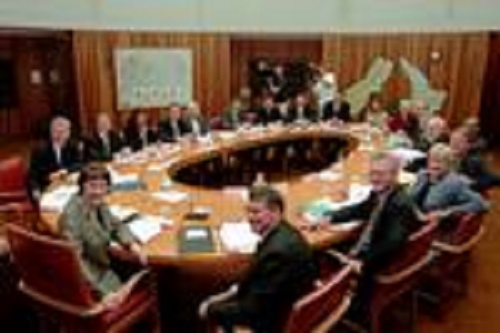
First Cabinet meeting of the fifth Labour Government, with Alliance and Labour members round the table – but not the Greens.
The 2002 Election
The Green Party achieved 7% of the vote and nine MPs. This was a 1.84% increase from 1999 in its party vote and an increase of 2 MPs. The election result was a very divided one, with seven political parties gaining seats in Parliament.
The party was shut out of a coalition with Labour because it would not agree to cede its bottom line on genetic modification during the election campaign. The Coromandel seat was lost to National. After a disastrous election night for the National Party, Labour was the largest party and was in a position to try to form a minority government. The Alliance was not returned to Parliament but the newly formed Progressive Coalition, led by Jim Anderton, was returned with two seats and remained allied to Labour, giving Labour 54 seats but not enough to govern. Labour had ruled out working with New Zealand First (13 seats), and could not reach agreement with the Green Party over its demands for a moratorium on GE, so the only remaining option was United Future, with 8 seats (up from 1). An agreement was signed with United Future to give the government confidence and supply, so the Greens were not needed and were not part of the new government. Labour now had its 62 seats required to govern.
However, Labour did need to call upon the Greens for support to pass certain legislation over the course of its 3-year term. The new government signed a “Co-operation Agreement” with the Green Party. This entailed a good faith understanding that the Greens and the government parties would maintain a constructive relationship. They agreed on a shared agenda and that they would cooperate on agreed areas of policy development, the Greens would treat government papers as confidential, quarterly meetings would be held with the Prime Minister, and other commitments. There was no requirement to be bound by collective responsibility, nor did the Greens gain any select committee positions. The parties agreed to adhere to the agreement for the course of the parliamentary term. The Greens’ negotiators were the co-leaders, chief of staff Deb Moran, and two party members, Olivia Mitchell and Gordon Jackman.
Commentators have noted that both Labour and the Greens were motivated to secure this deal by a desire to heal rifts from the tensions of the election campaign and the previous term, and a recognition that should the parties on the centre-left not cooperate, this would increase the likelihood that the centre-right parties could gather strength and work together in a future election. Unlike in 1999, the Cooperation Agreement was a formal document that was signed on the 26th August, 2002, just a month after the election. Although Clark did not need the Agreement to govern, she was wise to keep the Greens at least at the door to her tent, opening the way to possible greater co-operation, should it be needed, in 2005.
The 2005 Election
The campaign did not go well for the Greens, and the party just scraped back in with 5.3% of the vote, which returned 6 list MPs. The Green vote was partly affected by voters on the left returning to Labour, fearing that the election would be close and very concerned that a National government, headed by the contentious Don Brash, was a real possibility.
As it transpired, the election (held 17 September) result was very close, with Labour only two seats ahead of National and with neither party able to form a government alone.
On 5th November 2005, Co Leader Rod Donald died suddenly at his home in Christchurch. He left a wife and three daughters, and a party in mourning. The Prime Minister and hundreds of other people attended his funeral at Christchurch Cathedral. He died only a few weeks after his 48th birthday. The shock at his death was considerable. The House suspended day’s business and observed a minute’s silence in the House. The party was left reeling, with Jeanette Fitzsimons continuing alone as party leader.
The Green Party was shut out of a coalition with Labour because the smaller parties that did form a confidence and supply agreement with Labour, New Zealand First and the United Future Party, refused to cooperate if the Greens were part of government. With the loss of Rod, it looked to be a difficult new term ahead for the party.
In late 2004, Russel Norman was appointed Campaign Manager for the 2005 election. Sue Bradford MP was appointed Convenor of the Campaign Committee.
The 2008 Election
The fortunes of the Greens improved at this election, as Labour’s vote dropped. The party scored 6.72% of the vote which which meant they had nine list MPs again. No electorate seats were won. National under John Key formed a new government, and the Greens entered into a memorandum of understanding to advance some policies such as home insulation.
The 2011 Election
This election returned the best result to date for the Greens – 11.1% of the vote and 14 members of parliament. The total votes cast for the Greens were 247,372.
The 2014 Election
In June 2102 the Green Party was polling at 14.8% in a New Zealand Herald poll. The final election result gave the party 10.7% of the vote, 14 list MPs and a total vote of 257, 329, an increase of 10,000 on 2011, but in an election where the overall number of votes cast also increased on 2011. It was an extraordinarily difficult election for the progressive parties and one widely acknowledged to be perhaps the strangest election in New Zealand’s political history.
The 2017 Election
Prime Minister Bill English announced that the date of 2017 general election was to be 23rd September.
On xx August Co-Leader Metiria Turei made a speech to the party faithful in Auckland in which she endeavoured to draw greater public attention to the plight of those in poverty in New Zealand including those on welfare benefits.
The speech was to spark an impassioned debate in New Zealand which sparked an extraordinary series of political events, delivering the Green Party one of its greatest shocks since the death of Rod Donald in 2005.
The 2020 election
The election was held in the overwhelming context of a global pandemic, which changed all the usual political settings.
References:
Introduction:
Dann, Christine: “From earth’s last islands: the global origins of Green politics”. PHd thesis, Lincoln University, 1999.
Green Party of Aotearoa New Zealand papers, Alexander Turnbull Library, Wellington.
MS group 1209: agendas, newsletters, minutes.
Personal collection of Green Party records, newsletters and membership records.
Vowles, Jack and Peter Aimer: Voters’ Vengeance. The 1990 election in New Zealand and the Fate of the Fourth Labour Government. AUP 1993.
1 Vowles and Aimer, 1993, p.127
2 Bernard Merwood, communication to party members, 19 September 1989
3 ATL MS-papers-9207-05; notes from early issues of Linkletter
4 Merwood, 19.9.1989
5 Dann, 1991
(6) Greenlink, newsletter of the Green Party of Aotearoa, Issue 1, December 1989
(7) Greenlink, Issue 1, December 1989.
(8) Greenlink, issue 1, December 1989
6 ATL MS-papers-8634-1, notes by Philip Chubb
7 ATL MS-papers – 2003-176-1/14
8 Greens: Minutes and Agendas, ATL MS-papers-8634-1
9 ATL MS-papers-8634-1
10 ATL MS-papers-8634-1, notes written by Chris Thomas of Wellington
11 Mike Smith, Brief CV, in statement in support of Green Party co-leadership bid in May 1995
12 Smith, 1995
13 Greenlink: the newsletter of the Aoraki Greens, Spring 1995
14. Palmer. The parliamentary years, by Raymond Richards, 2010, pp352-353
15. Speech by Jim Bolger launching the National Party’s election policy, 13 July 1990, sourced in the archives of the Environment and Conservation Organisations (ECO), 2 February 2016. File “Election 1990”.
16. The Labour and National press releases quoted here were accessed in Environment and Conservation Organisations of New Zealand file POL H1/National.
17. References to alternative Green parties are taken from papers in the Environment and Conservation Organisations file POL H1/Green politics.
 NZ Green Party History